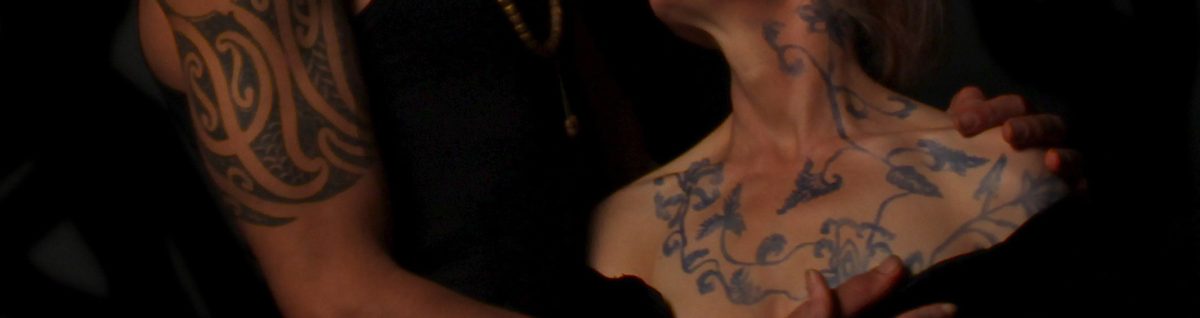
Walking the Wall, Angela Tiatia 2014
13.04 minutes. Single-channel High Definition Video. 16:9, colour, sound

Walking Through the Absurd
In his essay The Heart of Darkness (2004), Olu Oguibe writes, “If the Other has no form, the One ceases to exist.” This is part of his discussion on the duality of occidental cultures and ‘the others’, or indigenous cultures. One of his points being that in this global world the cultures from both sides of the fence are interconnected, and in art there is no denying this. Walking the Wall (Angela Tiatia, 2014), is such an artwork. In Walking the Wall Angela Tiatia uses her body to assert and explore female indigenous heritage and identity in a society annexed by Western culture. Of Pacific Island heritage Tiatia is very aware of the changing world in which we live. She has concerns about how globalisation does, and will affect people. Layered on this is both her particular connection with neo-colonialism and feminist views – these she believes, “sits on the body”. Scholarly discourse, and by association art, by and of indigenous people, are inevitably in some form connected to the body. Art by indigenously connected people such as Tiatia, whilst necessarily are therefore in part existentialist, are still pertinent to the contemporary art genre as they connect with and challenge the social and political global world in which we all live. This essay explores these concepts in Angela Tiatia’s art practice with a focus on her video piece Walking the Wall.
Our bodies are linked to cogitation. In Matter and Memory (1911), philosopher Henri Bergson recognised the influence the body had on the mind. Many indigenous cultures and religions connect the physical and the spiritual oftentimes using the body as a link. The body has played a role in art throughout history in tribal decoration, Greek plays, Renaissance humanism, and in more recent times of negation during the 1960s where the body was used in place of materials. Across the ages and different cultures women’s bodies have been subject to patriarchal control. So not surprisingly much feminist art, and that by women artists (and men), has used the body to express their thinking. Yoko Ono’s Cut Piece (1964) represents control as actions on women’s bodies. In The Reincarnation of Saint-ORLAN (1990-93), ORLAN exposes the enforced condition of physical beauty on women. Ana Mendieta used her art to spiritually re-connect with her stolen identity and with nature as in her Silhouette series (1977). Kiki Smith felt that the body functions as a language, and has fragility and elegance. Furthermore, that the body has been taken over by social forces and art is a means of taking back. Smith’s work Untitled (1990), depicts this losing control. In the 1990s Iranian-born Shirin Neshat used people in her photography and videos such as Rebellious Silence (1994) and Turbulent(1998), to raise questions of cultural perceptions, gender inequality and identity. The universal concepts of identity, connection and control seen in these examples that utilise the body as form and content can be noted in Angela Tiatia’s work, linking her art to this established heritage. Artistic lineage contributes to giving meaning to current art.
Tiatia’s outlook has been shaped by her personal development. She was born in her mother’s small Samoan village Fagamalo, to an Australian father. She has a Chinese grandfather. Her family joined the Pacific Island diaspora by following work opportunities to Auckland. Since 2012 Tiatia has been living in Australia. Tiatia has both a Bachelor of Commerce and a Bachelor of Visual Arts. She is well accustomed to being in the public eye as her career has included being a model, actress and television presenter. Tiatia feels she has a control over her body that she did not have during those times – sharing Kiki Smith’s sentiments. As an artist Tiatia has been exhibiting world-wide since 2010. Walking the Wall was displayed, along with four other works by Tiatia, in the 8th Asia Pacific Triennial, also known as ‘APT8’, in the Queensland Art Gallery, Australia where Tiatia joined artists from thirty nations including New Zealand. This exhibition was themed around the use of the body in art for social and political expression as well as ways in which artists can represent their cultural experience.
Such concepts are seen throughout Tiatia’s oeuvre which explores Samoan culture and diaspora with views on women, neo-colonialism, Chinese connections, globalisation and climate change. For Foreign Objects (2011), Tiatia collected items that defined representation of Pacific Islanders, for example ‘Hula Girl’ which are a category of figurines many of which sexualise Pacific Island women. This exhibition raised issues around ‘the gaze’ and historical objectification of Pacific Island people. Edging and Seaming (2012) put a human face on globalisation and the effect of capitalism on people’s lives. This two-channel video juxtaposes Tiatia’s mother in her work as a seamstress in her home-based workshop with clothing factory workers in Guangzhou, China. Both her mother and these workers are simply tools in an unfeeling politically managed global economy over which they have no control.
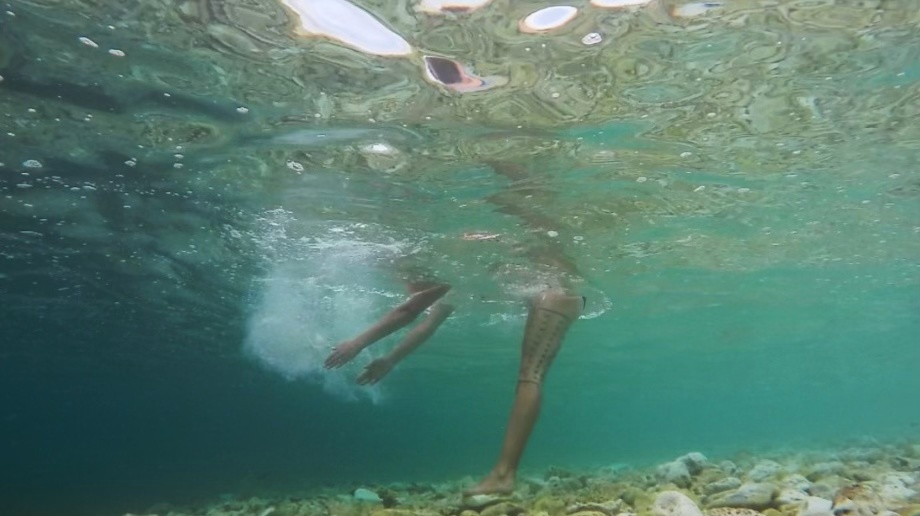
In Lick (2015), Tiatia physically tries to resist the sea in Tuvalu, raising awareness of the impact of climate change. She shows how debilitating on the body Western pop culture is in her Lady Gaga-esque Woman’s Movement (2016). Heels (2014), references the traditional Samoan taualuga in which the female dancer goes up on her toes. By beginning this video work in high heels and exposing her ‘malu’ tattoo, Taitia confronts such traditions and the duality of Western and Samoan cultures with their inflicting rules on women. As does Women’s Movement and Lick, this is body art with physical endurance, as such art often is. Taitia explains Heels as exploring “the tension I experience as walking the path between Western and Samoan culture.” Heels is part of an ongoing series by Tiatia called ‘An Inventory of Gestures.’ Walking the Wall is part of this series.
Like Heels, in Walking the Wall Tiatia exposes her sacred ‘malu’ tattoo, (‘tatau’ in Samoan). The Samoan ‘tatau’ is a painful body decoration marking a rite of passage in life. The female ‘tatau’ decoration is lighter than the male’s and traditionally was performed only on the daughter of the highest chief, but now Samoan women with acceptable family connections are eligible. The ‘malu’ is behind the knee and over the thighs. It is culturally taboo to reveal one’s ‘malu.’ In an interview for the APT8 exhibition Tiatia described Walking the Wall as a work of protest thereby putting herself through physical duress. As with Heels she juxtaposes the Western consumer symbol of high heel shoes with her Samoan ‘malu’. In both cases these symbols represent expectations placed on women and Tiatia sees the absurdity of walking up a wall as representative of how unreasonable these expectations are.
Walking the Wall is a single-channel widescreen video in colour, with sound, during which Tiatia, wearing a simple black leotard and stiletto shoes lying on her back with her eyes locked on the camera, ‘walks’ up and down a wall until she can no longer. The video runs for 13.04 minutes. The plain white walls throw emphasis on her shoes and ‘malu’. The video begins with unshod shoes on the floor. Tiatia enters the frame, puts on the shoes, places herself, still standing, in front of the side wall, fixedly looking at it before positioning herself lying on her back before it. She then proceeds to steadily ‘walk’ up the wall toes touching at first, then heels until she gets to the highest she can reach – which requires her raising her body onto her shoulder blades. We can see her leg muscles working in the process. After four minutes have elapsed she is beginning to struggle as her feet periodically slide down the wall and now and then she pauses. A couple of minutes further in our protagonist drags herself a little closer to the wall, rests briefly, takes a deep breath and returns determinedly to her task. Her action pushes her backwards so she needs to regularly re-position. This scenario repeats in a robotic manner which is occasionally broken with Tititia taking an audible breath and sagging sideways, showing us she is human. Despite her discomfort, with discernible show of will, Tiatia doggedly carries on. All the while her face remains mostly passive. After twelve minutes Tiatia ends her ‘walking’. She rolls over on her side, rests momentarily, returns to her back before removing her shoes, getting up and walking out of the frame. Faint marks line the white wall where her shoes have slid. Her demeanour is one of exasperation, just as she said she is with what she refers to as “the double standards within Samoan culture”. Males may show their tattoos, women may not. One gets the feeling she has been taken to task over this and here is her reply. A reply that shows a strength of will and call for respect.
The sound is made up of background traffic noise and the diegetic sound of the shoes moving on the wall. This sound and setting is suggestive of a gallery window indicating this is an artwork and we are non-participatory viewers. Video art like this can seduce but we remain apart. The only power we have is the choice to return to this technological temporality, as observers and nothing more, by replaying the video. Tiatia’s stare challenges us to share her duress placing an uncomfortable tension on this viewing experience. Despite this as viewers we are voyeuristically captivated by this video. In Art of the Digital Age (2006), Bruce Wands notes that we have an involuntary attraction to motion.
The enigma of Walking the Wall incites curiosity. If considering Laura Mulvey’s studies surrounding scopophilia there are a number of psychological enticements in the visuals of Walking the Wall. Mulvey points out in the introduction of the Second Edition to her Visual and Other Pleasures (2009), that riddles offer the viewer the “pleasure of decipherment”. A psychoanalytical facet of ‘the gaze’ which Mulvey raises that could be placed upon Walking the Wall is that of fetichism and curiosity as a process of displacement. High heel shoes frequently come up as a fetish item in the male objectification of women. There is also the element of the European sexual fantasy stemming from Imperial colonising of the Pacific as noted by Erika Wolf in her study of Shigeyuki Kihara’s artwork. Also a New Zealand artist Kihara shares some of the heritage and artistic themes of Tiatia. In an online discussion of one of her exhibitions Tiatia referenced a book called Anatomy of Paradise by J. C. Furnas. Originally published in 1937 Furnas writes of European colonisation of the South Seas relating stories such as the ‘greediness’ and ‘persistence’ of white seamen as they approached native women. He also relates tales of the missionary zeal to cover the islander’s bodies with clothing. Tiatia’s Inventory of Gestures series express these issues and relates them to current times.
My particular interest with Walking the Wall revolves around the indigenous body and contemporary art. Jean Robertson and Craig McDaniel ask, (is the body), “…biological organism or cultural artefact,” noting that “the body carries the visual signs that mark our identity.” This could not be more true than for cultures who mark their bodies. In these times of globalisation, as Terry Smith puts it, for ‘Fourth World,’ or ‘diaspora cultures’ art is important to contemporary indigenous people for defining their sense of identity. In an article entitled The Death of the Body(2005), Nicholas Blincoe asserts that fashion has resulted in an unhealthy obsession with body image and that has influenced the popularity among Westerners of tattoos. This fashion stems from the romantic notion of the spiritual superiority and beauty of indigenous people from the times of the nineteenth century romantic traveler, through Gauguin, to celebrities like Robbie Williams today. In the aforementioned article Blincoe also suggests that the body in contemporary art should be used ‘conceptually’ and not as ‘experience.’ I argue however, that for many artists exploring aspects of their heritage to be ‘contemporaneous’ as Terry Smith puts it, and being connected to the diverse global ‘we’of contemporary art, their body experience is often and inevitably part of the expression. The 2015 ‘APT8’ exhibition in which Tiatia and Kihara were participants, was an significant exploration of this very notion.
New Zealand scholar Brendan Hokowhitu takes those of Bergson’s era to task saying that the European did not understand the body as matter and the Enlightenment project of colonisation therefore failed. In the concluding sentence to his argument in Indigenous Existentialism and the Body (2009) he writes, “An Indigenous existentialism will recognise that the power of the body is still unknown and it is our choice to investigate the abyss.” Choice and freedom being the operative substance of his views. Further that while the past and the future are to be attended to, it is the here and now that should be of especial interest to indigenous studies.
Artwork such as Tiatia’s Walking the Wall is an exemplar of these visionary postulations. Scholars such as Hokowhitu and artists such as Tiatia are rejecting colonial precepts, looking at a future that is not defined by the past – because as Hokowhitu suggests by doing so “…keeps the colonial subject immutable,” and are advocating the freedom for the indigenous body to be ‘contemporaneous’ – should they choose. In Walking the Wall Tiatia’s ‘Western’ high heel shoes exemplify woman as ‘the gaze’, but by exposing her ‘traditional’ malu she is commenting on the expectation to be, at the same time, the opposite – that is hiding the female body. In her actions in this artwork she is presenting the ‘absurdity’ of these conflicting ideals placed on women within the indigenous milieu. It is not so much a show of annoyed rebellion but is one with the desire to make positive change by producing contemporary art that comments on control of the body. Tiatia straddles Oguibe’s dual cultures and with like mind to Hokowhitu is aware that the body is not only affected by neo-colonialism and political control but is instrumental to protest. Tiatita’s art therefore is of note for several reasons. By using her body, she is recognising the important indigenous element of the body that Hokowhitu has drawn attention to. She is continuing a feminist art heritage of challenging gender inequality and lastly, from her culturally diverse standpoint and protest art she is representing the global ‘we.’ In the Walking the Wall video art Taitia made her voice heard, showed her strength of will and at the end removed her shoes, in other words shackles, and freely walked away.
2461 words
Bibliography
Alcaston Gallery. “Angela Tiatia” Accessed September 2016. http://alcastongallery.com.au/artist/read/1259-angela-tiatia
“Angela Tiatia” Accessed September 2016. http://www.angelatiatia.com
Atkins, Robert. Artspeak: A Guide to Contemporary Ideas, Movements, and Buzzwords, 1945 to the Present. New York: Abbeville, 1997.
Blincoe, Nicholas. “The Death of the Body” 1 September 2005. Tate Etc. issue 5: Autumn 2005. http://www.tate.org.uk/context-comment/articles/death-body
Bergson, Henri. Matter and Memory. 1911. London: Allen, (Eighth Impression, 1970).
Forrest, Nicholas. 8th Asia Pacific Triennial Q&A: Angela Tiatia’s Body Battles. March 07, 2016.http://au.blouinartinfo.com/news/story/1348317/8th-asia-pacific-triennial-qa-angela-tiatias-body-battles
FRESH TV. Creative Native – Angela Tiatia – “Anatomy of Paradise.“ Published on 9 Mar 2012.https://www.youtube.com/watch?v=s-qAz4COV-4
Friend, Reuben and Angela Tiatia. Edging and seaming, Angela Tiatia. City Gallery Wellington 2013.
Furnas, J. C. “Anatomy of Paradise.” American Institute of Pacific Relations. 1937. Reprint New York: Gollancz, 1950.
Hokowhitu, Brendan. “Indigenous Existentialism and the Body.” Cultural Studies Review 15, no. 2 (09, 2009): 101-118.http://search.proquest.com.ezproxy.otago.ac.nz/docview/635921971?accountid=14700
Kalb, Peter R. Art Since 1980: Charting the Contemporary. London: Laurence King Publishing, 2013.
Kafka, Misha. “Mediating the Real.” Presentation for What the ‘Real’ Might Mean in Contemporary Media StudiesConference University of Otago, August 31st – September 2nd 2016.
Kuykendall, Kenneth L. “The Aisiga: A Samoan “Trick or Treat”” Oceania 50, no. 1 (1979): 31-36. http://www.jstor.org.ezproxy.otago.ac.nz/stable/40332225
Mulvey, Laura. Visual and Other Pleasures. 2nd ed. Basingstoke England; New York: Palgrave Macmillan, 2009.
Oguibe, Olu. “The Heart of Darkness.” In The Culture Game. Minneapolis: University of Minnesota Press, 2004. 3-9
Radner, Hilary. “La Peau Douce Francois Truffaut’s Passionate Object.” In A Companion to Francois Truffaut. Frist Edition. ed. Dudle Andrew and Anne Gillain. Blackwell Publishing, 2013. 469-488
Robertson, Jean and Craig McDaniel. Themes of Contemporary Art: Visual Art After 1980. Second ed. Oxford: Oxford University Press, 2010.
Rush, Michael. New Media in Art. Second edition. London; New York: Thames & Hudson, 2005.
Ryman, Anders. “Peti’s Malu: Traditions of Samoan Tattooing.” The World & I 19, no. 6 (06, 2004): 160-167. http://search.proquest.com.ezproxy.otago.ac.nz/docview/235845406?accountid=14700
Sharpe, Jenny. Allegories of Empire: The Figure of Woman in the Colonial Text. Minneapolis: University of Minnesota Press, Second printing 1997.
Smith, Terry. Contemporary Art: World Currents. Upper Saddle River, NJ: Prentice Hall, 2011.
The Vanishing Tattoo. “Robbie Williams.” Accessed September 29, 2016. http://www.vanishingtattoo.com/tattoo/celeb-williams.htm
Tyler Linda, “Setting Bodies in Motion.” Art News Autumn 2016. 66-67
Tyvola, Ema. “Foreign Objects” by Angela Tiatia. Published on 5 Mar 2012. https://www.youtube.com/watch?v=A33Wa6gnh7c
Walker, Charles with Laurent Antonczak, Andrea Eimke, Angela Tiatia and Clinton Watkins. “Exquisite, apart: remoteness and/as resistance.” eds. Cleland, K., Fisher, L. & Harley, R. (2013) Proceedings of the 19th International Symposium on Electronic Art, ISEA2013, Sydney. 2013. Accessed September 9, 2016. http://hdl.handle.net/2123/9757
Wands, Bruce. Art of the digital age. New York: Thames & Hudson, 2006.
Webb, Penny. “Artists’ Heritage is Under and on their Skin.” The Age, Aug 23, 2014. http://search.proquest.com.ezproxy.otago.ac.nz/docview/1555275229?accountid=14700.
Wolf, E. “Shigeyuki Kihara’s Fa’a fafine; In a manner of a woman: The photographic theatre of cross‐cultural encounter.”Pacific Arts, 10(2) (2010): 23-33.
List of illustrations and captions and sources of illustrations
FIGURE 1 Angela Tiatia, Walking the Wall, (2014, still image from digital moving image). Accessed September 1, 2016. http://www.angelatiatia.com/work
FIGURE 2 Angela Tiatia, Lick, (2015, still image from digital moving image). Accessed September 1, 2016.http://www.angelatiatia.com/work
 Bice Grace Lapin