Or should I say, ‘that is Robert Scott‘
Who is Robert Scott? Well, a famous Robert Scott is, of course, Captain Robert Falcon Scott, the doomed Antarctic explorer. A personality so steeped in legend that the man himself is buried somewhere within mysterious tales of adventure, heroism, and madness.
The Robert M. Scott of Dunedin, (Ōtepoti, Aotearoa), who came to my partner’s David Lynch themed 40th as a convincing Twin Peaks character – the FBI Gordon Cole, carrying a selection of Lynch soundtracks on cassette tapes, is, among certain circles, also steeped in legend.
Weird fiction is usually associated with literature and more recently, video games. Here however, I lay the term over Robert M Scott’s paintings and visual art. Keeping it local, lets reference Chris Lam’s 2024 University of Otago’s Master of Arts thesis titled The Simulated Weird, Video Games, Weird Fiction, and Gothic Horror.
'The weird of weird fiction emerges when a protagonist encounters a phenomenon irreconcilable with their understanding of the world. These are often terrifying encounters…Such encounters can also operate through the mode of awe, depicting the strange beauty of alien phenomena that have yet to be conceived… Such conceptions of the weird transform it into a tool of critical intervention, capable of disrupting the reader as much as theprotagonist'

My essay is written in celebration of Robert’s exhibition The Stand, showing at RDS Gallery, 6 Castle Street, Dunedin, 14 February to 31 March 2025 An associated booklet created for the exhibition comprises of essays by Alistair Fox, Sam Valentine and Amanda Mills. With perspicacity Alistair responds to both the exhibited works as well as Robert’s description of his art. With effervescence Sam writes of his awe of Robert, the artist and musician. With fresh perspectives Amanda knowledgeably sketches Robert’s prolific and energetic career as a musician. I’ll leave you to read further.
Robert is most famed for being one of The Clean and front person of The Bats, yet he is equally prolific in his visual art and paintings. The Kilgour brothers – David and the (sadly) late Hamish, the other two members of The Clean (yes that band associated with the world-followed Dunedin sound cult), also have made visual art. In contrast to David’s chirpy, jangly images, Robert’s work is steadfast, yet not entirely predictable- which is, not unlike the sound of his bass guitar.
A sense of the spooky, the creepy and the magical has been said of Robert’s paintings in The Stand. The Stand can mean many things. That’s your cue as a viewer – to make of it what you will. With their strong contrasts, the paintings of tress hold presence in the room. The shape of these trees are unique motifs in Robert’s work. “Draw what you see”, the voice of my school art teacher echoes in my head. Artists often do not aim to depict as our eyes decode; they depict what they see. They give us new and expressive ways of seeing and of responding. Robert’s tress and landscapes opens for us, new windows.
I mentioned Robert as being prolific. Many of us Dunedin-ite’s have a painting of his; or sixty, as another Dunedin icon Sam Chin, told me he owned. In my house there is one. Oh and a slightly creepy green genie with red eyes…
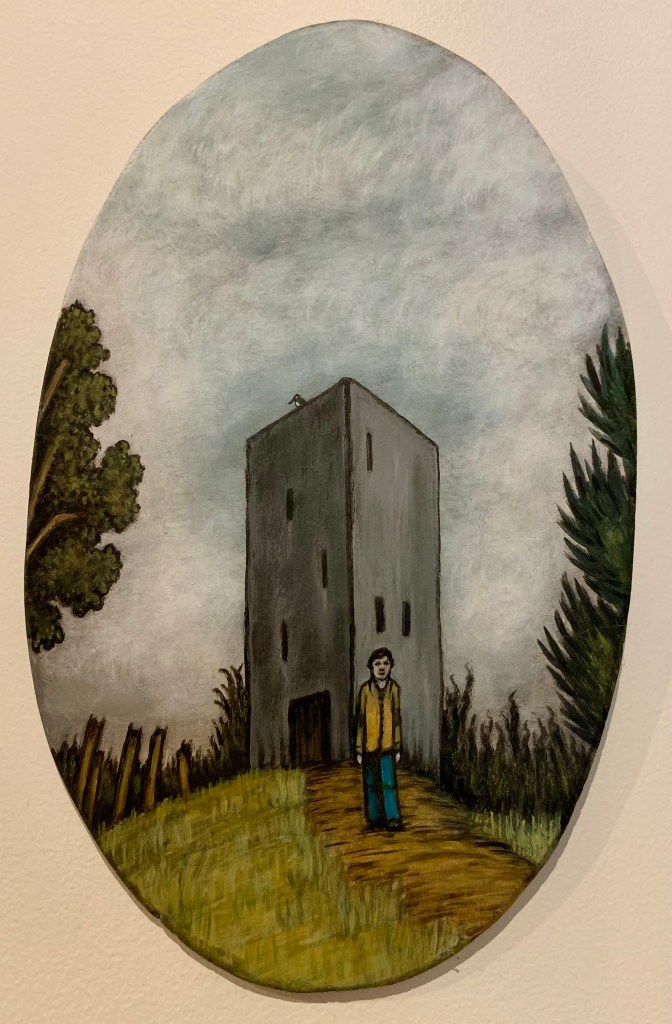
The 2010 painting on my wall, titled Grey Tower, is a small, tall oval shape. A male figure, looking obediently at the viewer as if posing for a photograph, stands passively on a wide pathway that leads up to a tall building not far behind. Two ‘off-stage’ trees are on either side, the grass appears trimmed, although due for a mow, while in contrast dark unruly shrubs surround the sides of the tower. The light blue sky is covered in wispy cloud. The matt colours are Robert’s recognisable blues, greens, yellow and grey. There is a Walter Benjamin moment-caught eeriness to the scene and a Benjamin ‘punctum’ – an aspect of a photograph which punctuates or punctures. In this case it’s a bird, with just it’s head exposed, sitting at the top of the tower looking over the scene, replicating the stare, at the viewer, of the figure below. Are we welcome or intruding? Expected or a surprise? Yet it brings a lightness, rather than a threat to the scene. This painting was after all, a gift to my partner shortly after building his new home. The figure owns this building and we cannot get to it without interacting with him. Such pictures exemplify the weird fiction of Robert Scott.
When I think of Robert, or ‘Bob’ to his friends, my picture of him as a person, is one that is always smiling. Even when things are grim and concern shadows his eyes, his smile never fades. It is a smile among friends that sews tears in the fabric. At the reception for The Stand we conversed cheerfully, but with a grey pallor in our cheeks as the news of a friend’s ill health event wisped it’s way through. We are a tight group of friends, despite in recent times we seldom gather. We are an unbreakable whanau and I marvel at our strength, as a group, at the aroha we have, that has spanned decades. I often wonder how it came about. Some may credit the Dunedin music scene, and yes there is that, but I know better. It has a point of coalescence. Our depth comes from death. The tragic accident of our friend, while years ago, has never stopped beating in our hearts. We pulled together as a warm blanket in those days at the hospital and ensuing times at Duncan Street. We wrapped our blanket we well as we could around our friend’s family, his wife and two young children – beloved to us all. Our lost friend, of course was not the first, nor the last. We group of friends are a blanket that stays warm through dark nights.
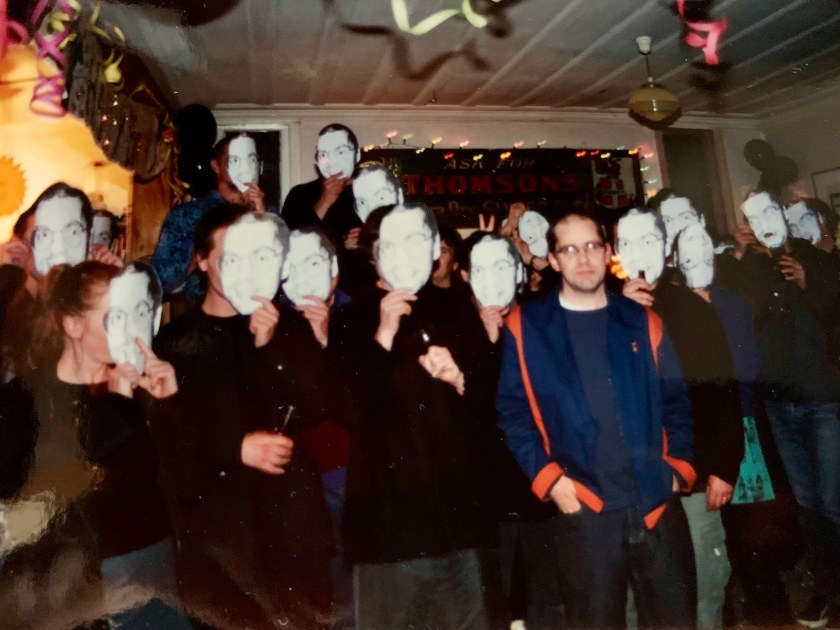
Bob is one of those people who can sit in an everyday kitchen, who can pick up his guitar and sing, without the slightest hint of pretension. I picture these scenes as being perfectly natural. Robert is not ‘big time’ famous but he is famous. His life has been full of creativity. Creativity comes from imagining story and fiction, from revising the real.
Who then, is Robert Scott? One of his stand-out qualities is the way he encourages other artists and musicians. He is an ardent football fan. And like another well known and well-loved Dunedin musician, The Chills’ Martin Phillips (who passed last year), Robert is a collector with a Peter Pan enthusiasm for life. Robert’s paintings reflect his interest in spooky gothic tales and in space, astronauts and jet planes. What would you like to be when you grow up Robert?
Robert’s art has reached a deservedly professional level and recognition. Well done Bob! We’re proud of you for living as the weird fun fiction you are, and we love you.
 Bice Grace Lapin