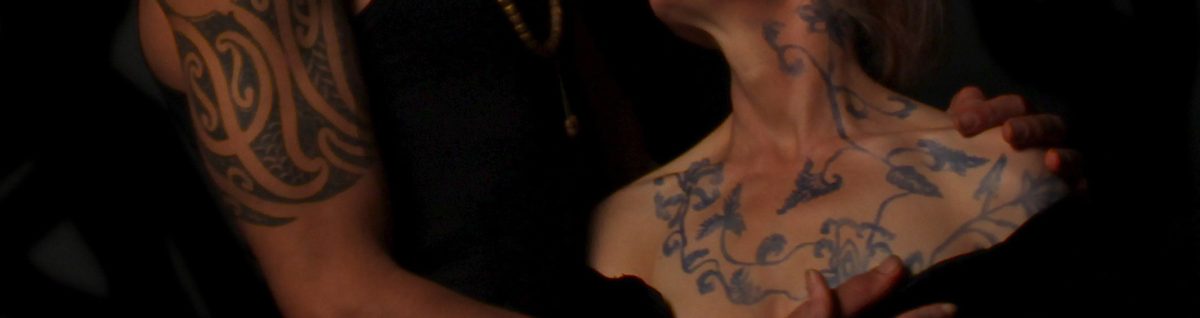
A short essay to accompany the ‘body art’ imagery.
Video artist Bill Viola who focuses on human experiences once said that your wound is where the light enters you, and that as long as you keep looking at the bandaged place you’ll see the pain and beauty.
In 2016-17 I researched and began a body art project, one to be further developed. My interest, as expressed through body art lies in how people can go against the tide, bridge oceans of difference, come together and support each other, without losing their personal history and selfhood.
Artists like Viola like to by-pass, evade, or penetrate the logical, reality-oriented protective layer, to arouse the deeper levels of the mind. The aspects of experience with which works of art are concerned – emotions, memories, desires – are stored in these depths. My aim with this project is explore those depths visually via our own bodies.
In Themes of Contemporary Art: Visual Art After 1980, Jean Robertson and Craig McDaniel ask, (is the body), “…biological organism or cultural artefact,” noting that “the body carries the visual signs that mark our identity.” This could not be more true than for cultures who mark their bodies. I have found especially thought provoking the work of Māori scholar Brendan Hokowhitu on the indigenous body and his views that Māori take ownership of their bodies away from colonial imprints – Foucault influenced of course. In a nation of mixed peoples Aotearoa’s strength is in understanding, love of each other and shared wisdom.
Coco Fusco might suggest my images to be a play on ‘ethno-porn’. This could be true, that like the New Zealand artists whose work inspires me such as Angela Tiatia, Lisa Reihana, Yuki Kihara and Greg Semu among others, it is work that may frustrate categorisation and assimilation.
In these times of globalisation, as art writer Terry Smith puts it, for ‘fourth world,’ or ‘diaspora cultures’ art is important to contemporary indigenous people for defining their sense of identity. Taking further this notion of the present of a merged diaspora with lingering links to the past, art theorist and philosopher Nicolas Bourriaud writes “No longer the separatism of colonial times but we now have global merging and ‘in-between’ identities’.” The challenge for my imagery in this project is how to portray identities that want to maintain their personal cultural heritage with the ‘in-between-ness’ which we find ourselves with.
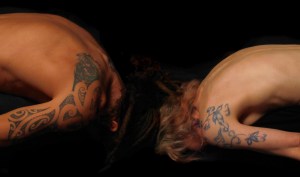
Following on from this, I look to give a visual interpretation to Olu Oguibe’s words, “If the Other has no form, the One ceases to exist.” We form our identities by looking at others valuing our differences and similarities. I use semiotics of identity via symbolistic designs drawn on the body, and fusing these images and bodies together in affinity.

Brief Bibliography
- Bourriaud, Nicolas. Relational aesthetics. Dijon : Les Presses du réel c2002
- Fusco, Coco. The bodies that were not ours : and other writings. London ; New York : Routledge, 2001
- Hokowhitu, Brendan. “Indigenous Existentialism and the Body.” Cultural Studies Review 15, no. 2 (09, 2009): 101-118
- Oguibe, Olu. “The Heart of Darkness.” In The Culture Game. University of Minnesota Press, 2004. 3-9
- Robertson, Jean and Craig McDaniel. Themes of Contemporary Art: Visual Art After 1980. Second ed. Oxford: Oxford University Press, 201
- Smith, Terry. Contemporary Art: World Currents. Upper Saddle River, NJ: Prentice Hall, 2011
 Bice Grace Lapin