
Feminist art historians Norma Broude and Mary D. Garrard wrote of the “blindness of male value systems in art history.” 17thC painter Rachel Ruysch became known as one of the greatest flower painters of her time, but there is more to her work. I refer to its mesmeric vanitas aspect, a reflection of womanhood? Yet Ruysch’s paintings and the woman herself live on. This essay looks at the Dutch society and time in which she lived, and how that helped Ruysch to be recognised as an artist when women artists were routinely unvalued or undermined.
Whoever is given by nature the first principles of the power of the principles of all arts and sciences is suited to study all arts and sciences: and to a woman these powers or principles are given by nature.
Anne Maria Van Schurman, 1647
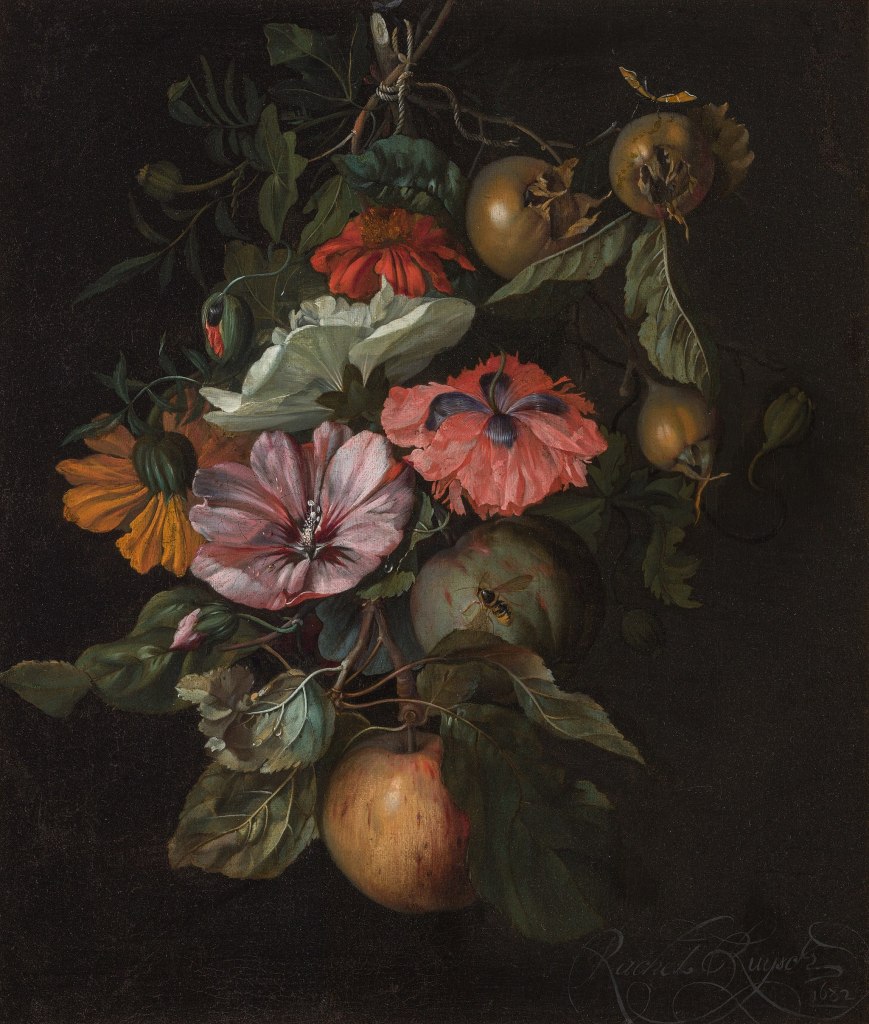
Seventeenth century Netherlands is referred to as The Dutch Golden Age. These were years when the Republic of what is commonly known as Holland was formed. In this time early capitalist markets developed, an urban middle class grew, science made strides and the arts flourished. The genre of still life painting was popular coinciding with interests in curios, science, nature, botany and flowers. It was an environment where some female artists found success, were recognised for their ability and paid well for their work. The most notable of these being Rachel Ruysch (1664-1750).
The writings of sixteenth century Giorgio Vasari (1511-1574) of Italy are considered to have set the path for art history. The Florentine based viewpoint from the Renaissance differs from movements in Northern Europe both in culture and in art. Yet Renaissance ideology influenced much of the following art in Western cultures and defined the prevailing art history discourse. If Michelangelo’s disparaging comments on Flemish painting embodies this ideology, it was supportive of neither still life painting nor women. So how did Rachel Ruysch become successful?
This essay will examine three key areas – the aspects of Dutch society that contributed to her ability to excel, the northern popularity of still life paintings, and whether recognition of Ruysch continued through history?
Research into known female artists in history shows that most of them are born into artistic families, oftentimes their father was an artist. The advantage of this is access to training, a studio and materials. Up until the nineteenth century women were mostly excluded from art schools and seldom allowed outside of the home for tuition. The disadvantage was that it was common practice for their father to take credit for their work. Painting was one of the gentile skills acceptable for women of well-to-do households to learn. But to take this onto a career path required a supportive family and if married, the husband.
Ruysch, who grew up in Amsterdam had such a family although her father’s primary profession was not art. He was a renowned anatomist who developed an embalming technique that brought him fame. He painted and illustrated his scientific publications. A few of Ruysch’s male relatives were artists and her grandfather was an important architect who built the royal residence in The Hague. The family thus had good connections. When young, Ruysch began painting. Her parents seeing her skill made the unusual choice of allowing her to study with the still life painter Willem van Aelst (1626-83). Being a woman excluded her from joining the Amsterdam painter’s guild which meant she could not sell her work as an independent artist. Her social position however, gave her access to wealthy patrons.
In 1693 Ruysch married portrait artist Joriaen Pool and although they were living in Amsterdam they became members of Confrerie Pictura in The Hague. It is suggested that due to her realistic depictions which earned her acclaim Ruysch was invited to join this painters fraternity. Ruysch’s sister Anna Ruysch was also known as a talented still life painter but like many women appears to have stopped painting after she married. Her known works are few and in 2007 one of Anna’s paintings sold through Christie’s auction house in London for over USD$100,000. Rachel continued painting after marriage, suggesting both that her husband was amenable to this, and that she desired to paint. Today in Holland married women maintain their maiden surname and this seems to be the case in Ruysch’s lifetime. This would help towards attribution of works for female artists. Pool had a regular business for his portraiture work so both husband and wife painted for money. In today’s literature Ruysch’s reputation is sufficiently strong as to avoid relational connotations. Her father, grandfather and husband are usually noted but as relatives to her rather than the opposite, as so often occurs in masculine oriented texts. Her 10 children however, are regularly referred to as if by continuing to paint Ruysch achieved a super woman feat. She is known to have taken time on her paintings so it could be deduced that by having an available studio, and an accepting husband she was able to work on them when time allowed.
There was also financial incentive. Ruysch’s paintings were sought after and attracted high sums. Tyler Cowan points out that once in the art market paintings by female artists often gained high prices, and that in her time a Ruysch sold for more than a Rembrandt, a fact often overlooked, even by feminist writers. Anna Koldeweij sees in Pool’s 1716 family portrait of himself, Ruysch and their youngest son Jan Willem, as a painting of modern relationships, with Ruysch as breadwinner, and that Pool is making a tribute to his wife. Pool himself is at the apex of this triangular composition but is shadowed by the lit Ruysch who is the central focal point and sits in a self-assured and casual pose. This portrait was a commission for Johann Wilhelm Elector Palatine, the patron of Ruysch from 1708 to his death in 1716. For her appointment she earned an annual stipend and supportive patron. Johann Wilhelm’s palace was in Düsseldorf but Ruysch and her family were permitted to stay where they lived, which at that stage was in The Hague. That Ruysch received this patronage could have come through both her reputation and her family connections. These connections that served her well. Johann Willem gave Ruysch’s Still-life with Fruit, Flowers, and Insects (1711) to his father-in-law Cosimo de’Medici of Tuscany. Since 1753 this has been in the Uffizi Gallery of Florence.
Two aspects of seventeenth century Dutch society that would have been helpful to Ruysch’s life as a female artist are its wealth, and its relative tolerance. A brief overview of the history of the Dutch people provides some insights. The lowlands being prone to flooding encouraged people to work together to overcome this adversity. An advantage of being by the sea and outlet for two major rivers was shipping access which meant trade. The area of the Netherlands was made up of disparate regions. Philip the Good of Burgundy (1396-1467) wished to unify the provinces of Netherlands of which he had control. He believed consistancy in laws, weights and measures would help and in 1464 he created the States-General with representatives of each of the provinces. In 1575 the first Dutch university was established in Leiden. After the Reformation Calvinist principles guided government and community but the Netherlands remained relatively tolerant of all religions. Holland and Spain were the first two nations to bring witch trials to an end in around 1610, about 50 yerars earlier than England and France. By 1648 The Netherlands had broken away from Spainish control and formed the Dutch Republic which being a center of commerce was Europe’s first bourgeoius state. From the thirteenth century sea faring traders in Flanders and Florance saw prosperous merchants and the beginnings of capitalism as enterprises grew in size and complexity.18 Hence Ruysch lived in a society and time that experienced relative wealth, openess and tolerance enabling her pursue her painting career.
Elizabeth Honig in her study of seventeenth Dutch genre painting analysed images of Dutch marketplaces which show that women dominate this public space. She concedes that men had upper-level power in commerce and finance but at the everyday urban level women were significant. She notes that this is verified by written observations writing that “Both locals and foreigners felt it to be something peculiar to and characteristic of the Netherlands, and it was constantly remarked upon throughout the sixteenth and seventeenth century.”
Furthermore, “That the Dutch accepted and even took pride in a configuration of gender roles that seemed so bizarre to most foreigners is quite remarkable.”
In the case of Judith Leyster (1609-1660) selling her art on the open market, and after marriage that of her husbands, was a matter of necessity. She was not born into a family that was financially comfortable as had Ruysch, or with connections to wealthy patrons. In 1633 she met the criteria to join Haarlem’s Guild of St Luke when she was in her early 20s. By then she was an independent artist, with her own studio and taking on pupils. Records of an incident she had over a pupil defecting to Frans Hals suggests she was financially independent and making her own decisions and had established herself as a painter. In Haarlem male painters dominated the market. For Leyster to have done as well as she did is an indication of the quality of her work as well as her tenacity to succeed. That she could follow her path at all was in part due to the mechanisms of the society she lived in.
Economically life differed for women in seventeenth century Europe. The Renaissance values had increased division between sexes. Upper class women were domiciled to the domestic sphere and classical ideals put women in subordinated roles turning them into aesthetic objects. As Whitney Chadwick describes it in Women, Art, and Society, the historical concept of the Renaissance is based on men. Yet in Italy the city of Bologna was outside of the main centers of Renaissane culture and was proud of it’s women intellectuals and achievers. Two of the better known among them were the painters Lavinia Fontana and Elisbetta Sirani. These two attained international reputations and were admired in their city.25
In Northern Europe pre-seventeenth century records show women working as artists, students in studios, running businesses and belonging to art guilds. In the Netherlands during the century preceding Ruysch and Leyster, two women who achieved recognition were Caterina van Hemesson and Levina Teerlinc. Teerlinc was one of several women employed in England as miniaturists and was well paid through royal patronage.
On the issue of women’s virtue and honour painting was a part of lady-like education and past-time. The Dutch acceptance of women in low-level commerce connects the two safely together. The growing bourgeois class of seventeenth century Holland were avid consumers of paintings so an increasingly high number of works were produced. While the middle class customer did not pay high prices, having this market allowed more low to middle-class people, women included to work as artists and sell their wares.
Northern European painting tended to present different themes to that of Italy with interest in topographical landscape and still life. In Holland everyday life, which became known as genre painting, was a popular subject. Perhaps for the intelligentsia still life had an especial appeal and flower paintings garnered some of the highest prices. This is despite being low on the Italian list of ideal subject matter. The Dutch international trade brought home curios and items of scientific interest, as well as fruit and plants. There was a growth of interest in the natural sciences which no doubt was encouraged by the Dutch invention of the microscope in the late sixteenth century. They became collectors of rare objects, insects and butterflies. The study of horticulture was an activity for the wealthy, there was a passion for gardens and flower cultivation and delight in the beauty of plants. The Dutch became Europe’s leading horticulturalists. Floral designs linked into embroidery which provided many women with work. There was the “tulip craze.” Bulbs came from Turkey and were high-priced sought after items. Work on tulip catalogues were another source of income for female artists. This all aided the popularity of women produced still-life paintings.
Another recognised female still life painter in Holland was Clara Peeters (1594-1657), although the term still life did not appear until around 1650. Her ‘formation’ paintings were some of first notable still life paintings of seventeenth century. Two other successful female artists working at a similar time to Ruysch were Maria van Oosterwyck (1630-1693) and Maria Sybilla Merian (1647-1717). Oosterwyck was greatly admired in the low countries and like Ruysch had good royal patronage. Merian was an artist, botanist and entomologist. She published several volumes on plants and insects which gained attention all over Europe covering some ground-breaking science. Three hundred years after her death, Merian will be celebrated at an international symposium in Amsterdam this June 2017.
Elizabeth Honig in Desire and Domestic Economy 2001, discusses the debates on Dutch painting regarding realism or symbolism. She believes both readings are there and this reflects the Dutch conflicting ideologies in the world they experienced. After the Council of Trent (1545–63) forbade religious imagery of the traditional form, “hidden messages” may have taken on more importance. The concept of Vanitas relates to mortality and transcendence. Subjects that can be depicted in images of plants and insects. Flower painting also come from a heritage of herbal and scientific depictions of plants.
Ruysch’s paintings embody all these things in visual theatre that captured great interest. Through her father Frederick Ruysch, Rachel was able to do botanical studies. He was closely involved with botany and horticulture and with his preserving technique would have helped provide plants and insects for study. Ruysch’s work was life-like with her faithful renditions earning her acclaim. Important developments in still life came from the Dutch and Ruysch’s work influenced followers. The genre continues to this day with varied interpretations.
Other notable women in seventeenth century Holland includes the scholar Anna Maria Schurman. An artist as well, she was given honorary membership to the Utrecht St Luke Painters Guild in 1643 in recognition of her varied artistic skills. She was, best known for languages, theology and philosophy. Schurman was the first woman to attend lectures at university at Utrecht in 1641 and wrote a dissertation in Latin on the suitability of women for scholarly study and work. This sparked debate on the subject and there were some negative responses. She was however, highly regarded throughout Europe and she corresponded with learned men and women. One of the points Schurman makes in her dissertation is that with the favourable conditions politically and economically there was no reason why women should not be able to access the education that was considered so worthwhile for men.
We can take from this that while the Dutch Republic was perhaps not fully enlightened on gender equality the political and economic circumstances, along with the recognition and respect a number of women achieved, shows that seventeenth century Dutch society was relatively open to their ambitions.
As Whitney Chadwick points out attribution is important to female artist’s continuing recognition. That Leyster had been virtually lost to history was in part due to this. Frima Fox Hofrichter analysed recognition of Leyster through history. She discovered that Leyster was virtually forgotten from her death until rediscovery 1893 by a Dutch art historian. Before then no museums held any works attributed to her. Her recognition had been eclipsed by her husband Jan Miense Molenaar, and much of her work had been attributed to Frans Hals. Hofrichter’s study shows numerous incidences where Leyster was disregarded. Chadwick sees Leyster’s case as ”irrefutable evidence of the ways that seeing is qualified by greed, desire, and expectation.”
In the case of Ruysch much of her work has passed from her noble patrons to major museums and other wealthy owners, and her attributions remained strong. Some of the art history language referring to Ruysch is disappointing. Jan van Huysum (1682-1749), was also a successful Dutch flower painter, inspiring his biographer Johan van Gool to write in 1751 that the artist was “Famed for his splendid fruit and flower scenes. The only Phoenix of that noble art.” Van Gool was also Ruysch’s biographer who wrote after meeting her two years before her death, “For a woman of such a ripe age” she had kept “her mind and her appearance wonderfully well.” This is an example of the type of discourse Norma Broude and Mary D. Garrard refers to as the “Blindness of male value systems in art history.”
To conclude I have noted aspects of society in the Dutch Golden era that were favourable to Rachel Ruysch’s artistic career and the acknowlegement she recieved. It was good economic times when her art was sought after, and the culture was, to a point, amenable to a female artist being successful. Ruysch’s family support and place in society contributed. Her personal situation allowed her to paint throughout her life despite there not be a financial requirement to, (as well as her profitable commission her family won a significant amount of money in the lotteries). We can surmise that she painted for joy. The provenance of her works is such that her name has remained connected to the contribution she made to the genre of still life, flower painting. As Aidan Dunne notes in his 2015 article Ruysch’s works still fetch high prices today, that in her paintings, “you are seeing a whole, indeed infinite, world,” but “enduring cultural prejudice” is indicated by her not being placed up with her male counterparts.
Bibliography
Alpers, Svetlana. “Art History and Its Exclusions: The Example of Dutch Art,” In Feminism and Art History: Questioning the Litany. edited by Norma Broude and Mary D. Garrard. New York: Harper & Row, 1982. 183-199.
Broersen, Ellen.“’Judith Leyster’ A Painter of ‘Good, Keen Sense.’”In Judith Leyster: a Dutch Master and Her World, 15-38. Worcester, England: Yale University Press, 1993.
Broude, Norma and Mary D. Garrard “Introduction: Feminism and Art History,” In Feminism and Art History: Questioning the Litany, edited by Norma Broude and Mary D. Garrard. New York: Harper & Row, 1982. 1-17.
Norma Broude and Mary D. Garrard. New York: HarperCollins, 1992.
Chadwick, Whitney. Women, Art and Society. Second Edition. London: Thames and Hudson, 1996.
Christies Auctions. Accessed May 10, 2017. http://www.christies.com/lotfinder/paintings/anna-ruysch-a-bunch-of-grapes-two- 5022023-details.aspx.
Cowen, Tyler. “Why Women Succeed, and Fail, in The Arts.” Journal of Cultural Economics Volume 20, Issue 2 (March 1996): 93–113.
Dunne, Aidan. “A Ruysch Moment on a Turner Prize Break.” The Irish Times (1921-Current File). December 19, 2015. Accessed 10 May, 2017.
Editors Encyclopedia Britannica. “Rachel Ruysch.” Britannica Academic. 3 Feb. 2017. Accessed May 1, 2017. academic.eb.com/levels/collegiate/article/Rachel- Ruysch/442750.
Harrison, Charles and Paul Wood. Art in Theory 1900-200 Anthology of Changing Ideas. New Edition. Cornwall: Blackwell, 2003.
Higonnet, Anne. ‘Secluded Vision: Images of Feminine Experience in Nineteenth-Century Europe (1987)’, in The Expanding Discourse: Feminism and Art History, edited by Norma Broude and Mary D. Garrard. New York: HarperCollins, 1992.
Hofrichter, Frima Fox. “A Light in the Galaxy – Judith Leyster.” In Singular Women: Writing the Artist, edited by Kristen Frederickson and Sarah E. Webb. 36-47. Berkeley: University of California Press, 2003.
Honig, Elizabeth Alice. “Desire and Domestic Economy.” Art Bulletin 83 (2001): 294 – 315.
Hooker, Mark T. The History of Holland. Westport, Connecticut: Greenwood Press, 1999.
Irwin, L. Joyce. “Learned Woman of Utrecht.” In Women Writers of the Seventeenth Century, edited by Katharina M. Wilson and Frank J. Warnke.164-185. Athens: University of Georgia Press, 1989.
Keyes, George S. and Susan Donahue Kuretsky, Axel Ruger, Arthur K. Wheelock Jr. Masters of Dutch Painting: the Detroit Institute of Arts. London: Detroit Institute of Arts, in association with D Giles Ltd. 2004.
Klein, Joanna. “A Pioneering Woman of Science Re-Emerges After 300 Years.” The New York Times. January 24, 2017. Accessed May 10, 2017. http://www.nytimes.com.ezproxy.otago.ac.nz
Kooijmans, Luuc. “Online Dictionary of Dutch Women.” Digitaal Vrouwenlexicon van Nederland. Adopted by Elisabeth Wielenga-Puylaert. Last updated January 13, 2014. http://resources.huygens.knaw.nl/vrouwenlexicon/lemmata/en
Koldeweij, Anna. “A ‘Modern’ Artist Couple Portrayed: Juriaan Pool and Rachel Ruysch in 1716.” In the Symposium Likeness and Kinship Artistic Families from the Seventeenth Century Portrayed. Rubenianum, Antwerp. June 22, 2015. http://colloquium.rubenianum.be.
Mentor, William. “Women in the Age of Reformation.” In Becoming Visible Women In European History. Edited by Renate Bridenthal, Claudia Koonz and Susan Stuart, 202-219. Boston: Houghton Mifflin Company, 1987
Mitchell, Peter. “Flower painting.” Grove Art Online. Oxford Art Online. Oxford University Press. Accessed May 8, 2017.
http://www.oxfordartonline.com/subscriber/article/grove/art/T028702.
Noordegraaf, Leo and Thera Wijsenbeek-Olthuis. “Painting for a Living: The Economic Context of Judith Leyster’s Career.” In Judith Leyster: a Dutch Master and Her World, edited by James A. Welu and P. Biesboer 39-54. Worcester, England: Yale University Press, 1993.
Packer, Michelle V. “The Temptations of Flora.” Veranda, Jan/Feb 2007, Vol.21. Accessed May 8, 2017.
Van Eck, Caroline. “The First Dutch Feminist Tract? Anna Maria van Schurman’s discussion of women’s aptitude for the study of arts and sciences.” Choosing the Better Part Anna Maria van Schurman (1607-1678). Edited by Mirjam Baar; Machteld Löwensteyn; M. E. Monteiro; A. Agnes Sneller. Dordrecht: Springer Netherlands 1996.
Van Miegroet, Hans J. “Still-life.” Grove Art Online. Oxford Art Online. Oxford University Press. Accessed May 8, 2017.
http://www.oxfordartonline.com/subscriber/article/grove/art/T081448.
Vigué, Jordi. Great Women Masters of Art. New York: Watson-Guptill, 2002.
Wiesner, Merry E. “Spinning Out Capital: Women’s Work in the Early Modern Economy.” In Becoming Visible Women In European History. Edited by Renate Bridenthal, Claudia Koonz and Susan Stuart, 220-249. Boston: Houghton Mifflin Company, 1987.
 Bice Grace Lapin